

Overview
Both Spotlight FX and AEJuice answer the same question: how do you drop professional-looking transitions, titles, and effects into a timeline without building everything from scratch? The overlap is real. Both live inside After Effects and Premiere Pro as panels, both use double-click-to-import workflows, and both include commercial licenses. But the similarities mostly stop there.
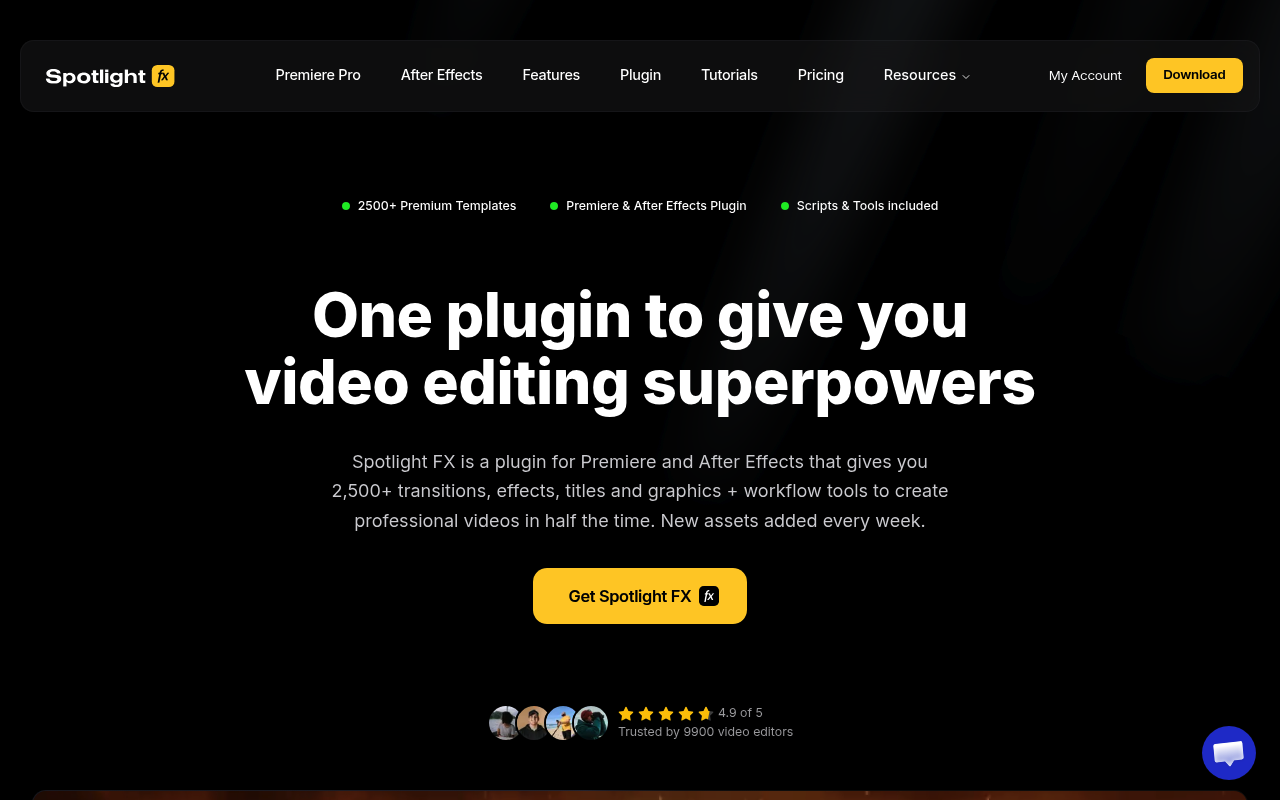
Spotlight FX is a cloud-first plugin with roughly 2,500 assets managed through a single interface, built in-house and updated automatically. AEJuice is a catalog of 30,000-plus assets across 300-plus categories, delivered through a locally installed Pack Manager, with content sourced from both in-house and third-party creators. If you edit primarily in After Effects or Premiere Pro and want a tightly curated, automatically updated library with included workflow scripts, keep reading. If you edit across multiple NLEs or want the deepest possible asset library for a single purchase price, this comparison matters to you too.
Features Side by Side
| Feature | Spotlight FX | AEJuice |
|---|---|---|
| Total assets | 2,500+ | 30,000+ |
| Free tier | 40+ assets, all workflow tools | Starter Pack (100+ assets) |
| Asset delivery | Cloud-based, auto-download to timeline | Local Pack Manager, manual pack installs |
| Workflow scripts included | Yes, built into Toolbox (Anchor Point Mover, Looper, Keyframe Easing, etc.) | Separate utilities (Toolbar, Export GIF, alignment tools) |
| AI tools | No | Auto Captions, Voiceover AI, NeonMind AI (all with free tiers) |
| Software support | After Effects, Premiere Pro only | After Effects, Premiere Pro, DaVinci Resolve, FCPX, Sony Vegas, others |
| Asset update model | Automatic via cloud | Manual pack downloads, new packs require subscription or separate purchase |
| Semantic/intent search | Yes (since June 2025) | Standard keyword/tag search |
The library size gap is the first thing most people notice: 30,000 versus 2,500. That number is real but needs context. AEJuice’s 30,000-plus figure includes assets across hundreds of packs from multiple creators, which means significant quality variance. Community discussions consistently describe a portion of the library as generic or underdeveloped. Spotlight FX’s 2,500 assets are built in-house and stress-tested on real projects, which keeps quality more consistent but obviously limits variety.
The workflow script situation is a genuine differentiator in Spotlight FX’s favor. Anchor Point Mover, Keyframe Easing, Looper, Bulk Renamer, and the OBS Chapters Extractor are included free for all users, including the free tier. AEJuice has some utility scripts too, but they’re scattered across separate products rather than bundled into one panel. For After Effects users who want a single plugin that handles both asset delivery and common scripting tasks, Spotlight FX covers more ground.
AEJuice’s AI tools are the clearest area where it leads. Auto Captions, Voiceover AI, and NeonMind AI (a Stable Diffusion image generator inside AE) have no equivalent in Spotlight FX. The AI tools have significant limitations at the free tier and mixed reviews on reliability, particularly NeonMind AI, which multiple users report as non-functional or buggy. But if AI-assisted captioning or voiceover generation matters to your workflow, Spotlight FX has nothing to offer there at all.
Pricing
Spotlight FX uses a freemium model. The free tier gives you 40-plus assets and all workflow tools with no time limit. Paid plans: $29/month billed monthly, or $14/month billed annually ($168/year). A lifetime option costs $299 one-time, which includes one year of new asset additions. After year one, you can optionally pay $49/year to continue receiving new assets, but all previously downloaded assets remain yours permanently regardless of renewal status. Billing is via LemonSqueezy with a 14-day refund policy if fewer than 10 premium assets have been downloaded and not used commercially.
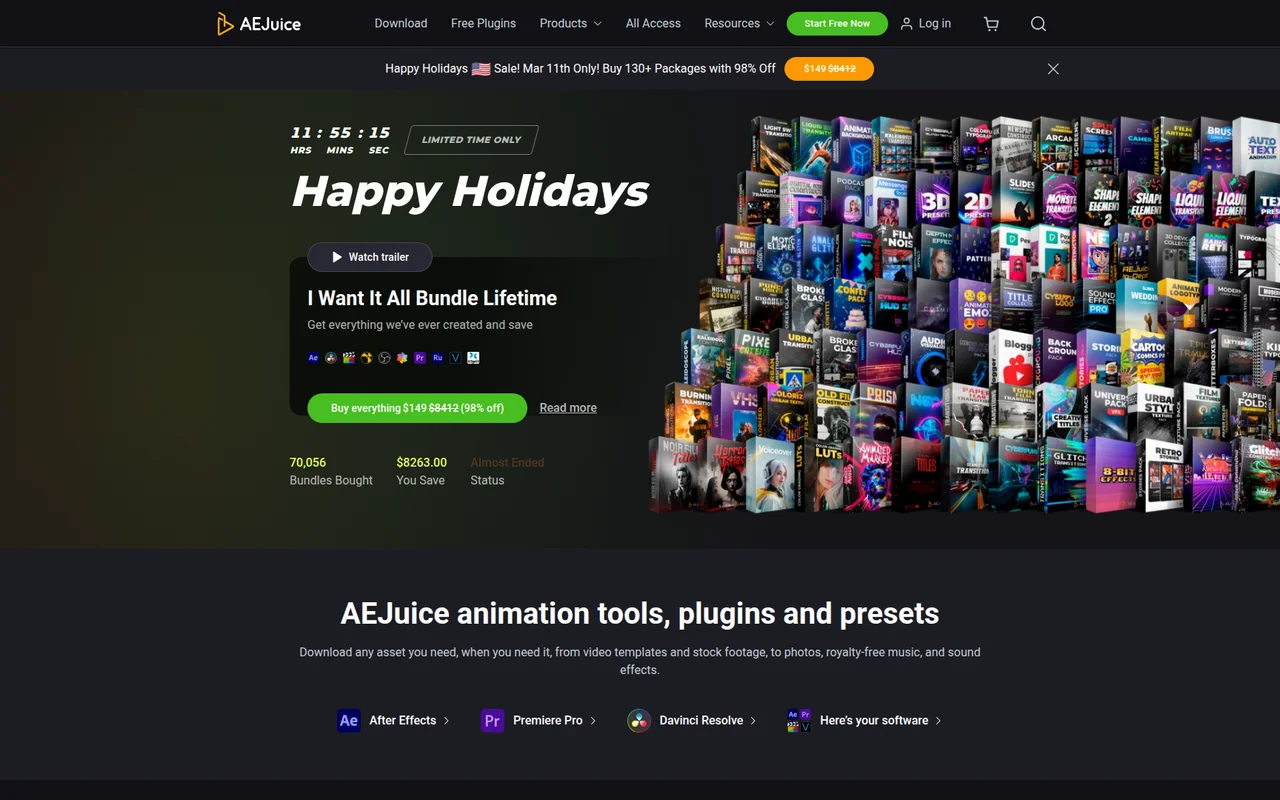
AEJuice offers a free Starter Pack with 100-plus assets through Pack Manager at no cost. Paid options: All Access Monthly at $59/month, All Access Annual at $468/year ($39/month). The flagship one-time purchase is the “I Want It All Bundle Lifetime” at $149, which includes 134 packages and 30,000-plus assets available at time of purchase, but excludes future releases and certain third-party content like VFX packs and courses. Specialized bundles are also available: VFX Infinity Bundle ($199), Film VFX Bundle ($347), Text Animation Bundle pricing starts at $249. AEJuice runs frequent heavily discounted promotions, and community members note the “sale” pricing appears to run year-round.
For the annual subscription comparison: Spotlight FX costs $168/year versus AEJuice’s $468/year. For a one-time purchase: Spotlight FX lifetime is $299 versus AEJuice’s $149 bundle. If a one-time payment is your priority, AEJuice wins on price by a significant margin. If you prefer a lower annual subscription with automatic asset updates, Spotlight FX is considerably cheaper.
Performance and Workflow
Spotlight FX’s cloud architecture means assets arrive in your timeline via double-click with no local library management required. The non-destructive track placement logic, introduced in late 2024, places assets on a new track above your footage rather than overwriting clips, which is genuinely useful when experimenting quickly. Cross-device sync keeps liked items and downloads consistent across machines. The trade-off is internet dependency: browsing and downloading new items requires a connection, and the font scripting limitation, acknowledged in their documentation, means you change fonts through After Effects’ native panel rather than within Spotlight FX.
AEJuice’s Pack Manager is locally installed, which means once you have packs downloaded you’re not dependent on a connection. That’s an advantage for editors working in low-bandwidth environments or on location. However, the performance overhead is a documented problem. Community reports include system-wide lag from background processes that run even when Adobe software is closed, and several high-spec machines have been reported as effectively unusable after installation. Complex constructor packs in particular are noted as performance-heavy. The Premiere Pro integration is also less stable than the After Effects side: blank plugin panels, MOGRTs failing to render, and transition scripts that require restarting the application are recurring complaints.
Spotlight FX’s performance record is cleaner by comparison. Bug fix logs show active maintenance, including resolved crashes from complex blending modes and rendering issues in Premiere Pro, but the severity and frequency of reported issues is lower than what surfaces in AEJuice community discussions.
Who Should Pick Which?
Choose Spotlight FX if:
- You work exclusively in After Effects and Premiere Pro and want a single plugin that covers both assets and workflow scripting without managing separate tools
- You want automatic asset updates and prefer not to manually manage a local library of packs
- You produce content in specific genres (wedding, YouTube, true crime, hip hop music video) where genre-specific curated collections save setup time
- You want the lowest annual subscription cost for a premium asset library
Choose AEJuice if:
- You edit across multiple NLEs, particularly DaVinci Resolve or Final Cut Pro, where Spotlight FX does not work at all
- You want the largest possible asset library for a single one-time purchase and are comfortable managing a local Pack Manager
- AI-assisted tools like Auto Captions or Voiceover AI matter to your workflow
- You need highly specialized VFX packs (fire, smoke, liquid elements, complex 3D constructors) that go beyond what a general-purpose library provides
Verdict
For most After Effects and Premiere Pro editors choosing between these two, Spotlight FX is the more practical day-to-day tool. The automatic updates, tighter asset quality, included workflow scripts, and lower annual subscription price ($168/year versus $468/year) add up to a better value for editors who live in the Adobe ecosystem. AEJuice’s raw library size looks compelling on paper, but community evidence consistently points to performance instability, quality inconsistency across packs, and Premiere Pro bugs that can make the product unusable on some machines. Where AEJuice wins clearly is the one-time purchase scenario: $149 for 30,000-plus assets beats Spotlight FX’s $299 lifetime price on volume alone, and if you edit outside Adobe’s ecosystem, AEJuice is the only option here that supports your software.